ORIGIN OF TAEKWON-DO
After Korea achieved independence in 1945, 2nd Lieutenant Choi Hong Hi was released from the Japanese prison and was put in a position as a founding member of the just organized Republic of Korea Armed Forces.
The ROK demonstration teams, led by Choi, were later to become famous for their amazing skill displays while spreading the art across the world, initially Vietnam, Malaysia and other areas. Many famous Taekwon-Do Masters of today were members of these demonstration teams.
A whole chain of events led to the origin and development of Taekwon-Do by General Choi Hong Hi. He had some prior knowledge of Taekyon and the learning of Karate in Japan during the Japanese occupation of Korea.
His Knowledge furnished him with the ability to create, while his rank empowered him to propagate Taekwon-Do throughout the whole army, in spite of strong opposition. He started developing new techniques systematically from March 1946. By the close of 1945, he had almost finished the foundation of a new martial art for Korea, and on April 11, 1955, it was named Taekwon-Do. This single unified name of Taekwon-Do submitted by GEN. Choi Hong Hi replaced the different and confusing terms Dang Soo, Gong Soo, Taekyon, Kwon-bup etc., prevailing in Korea.
HISTORY OF TAEKWON-DO
Ever since man first walked the earth, he has been using his hands and feet for self-defense. These physical actions gave rise to martial arts, a process which is still a perplexing mystery.
RMA (448 A.D – 529 A.D) the third son of the Indian King Brahman who was known as the 28th patriarch of Buddhist Zen. He reportedly traveled from an Indian monastery to China instructing in areas of Buddhism (Zen). During his visit he introduced Buddhist monks, in the Shaolin temple, to a form of a mental and physical conditioning and training involving a set of 18 postures (similar to Tai Chi) imitating temple idols. As a result these monks became the most formidable fighters in china. Their style later became known as Shaolin boxing.
As Buddhism became increasingly popular, it spread throughout other Asian countries like Philippines, Thailand, Indonesia, Korea and Japan. An increased interaction between these countries allowed for some comparisons and further development of their fighting styles, and also variations in styles became apparent between countries and these actions were named as suited to the language of different countries by the practitioners, for e.g., Kalaripayattu or Selambam (in India), Judo, Karate, Jiujutsu or Aikido (in Japan), Kung Fu, Wu Shu, Tai Chi or Daeji-Chon (in China), Savate ( in France), Samba ( in Russia), Bosilat ( in Malaysia), Kick-Boxing ( in Thailand), Taekyon, Soo-Bak-Gi or Taekwon-Do ( in Korea).
After the Japanese occupation of Korea in 1909, the practice of martial arts by Koreans was forbidden and the only major survivor of this catastrophe was Taekyon with much training carried out in secret.
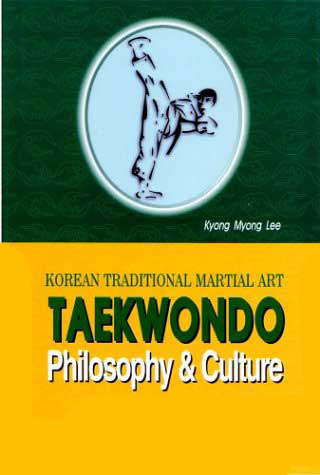
PHILOSOPHY OF TAEKWON-DO
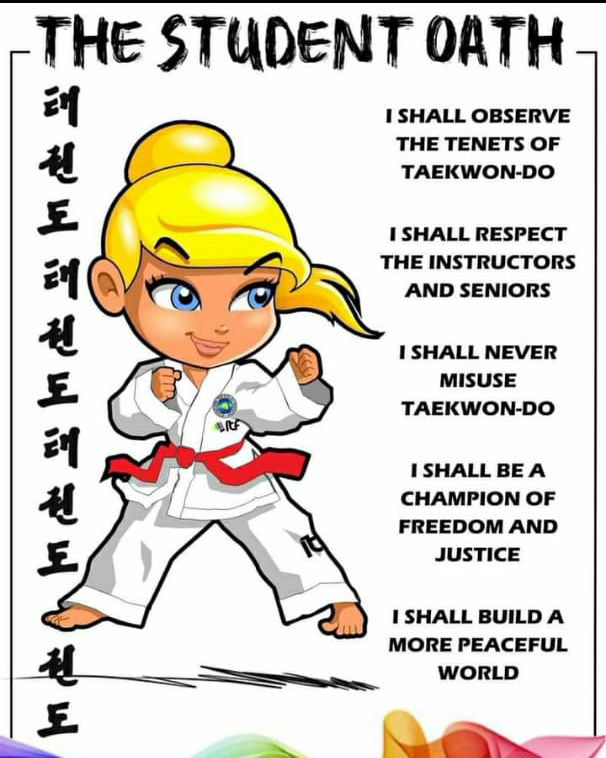
The utmost purpose of Taekwon-Do is to eliminate fighting by discouraging the stronger’s oppression of the weaker with a power that must be based on humanity, justice, morality, wisdom and faith, thus helping to build a better and peaceful world. Righteous men, deplore the fact that justice does not always triumph over the tyranny of power. However, there are ways to deal with these problems: The former, through mental discipline, the latter through physical training.
- 1. Be willing to go where the going may be tough and do things that are worth doing even though they are difficult.
- 2. Be gentle to the weak and tough to the strong.
- 3. Be content with what you have in money position but never in skills.
- 4. Always finish what you begin, be it large or small.
- 5. Be a willing teacher to anyone regardless of religion, race or ideology.
- 6. Never yield to repression or threat in the pursuit of a noble cause.
- 7. Teach attitude and skill with action rather than words.
- 8. Always be yourself even though circumstances may change.
- 9. Be the eternal teacher who teaches with the body when young, with words when old, and by moral percept even after death.
MORAL CULTURE -
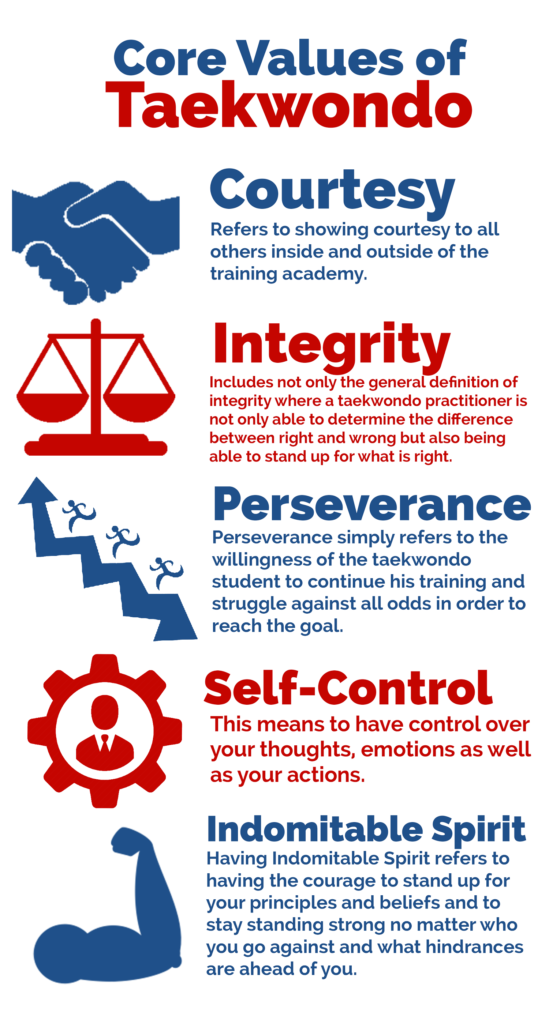
Confucious said, “To promote the sense of morality one must treat others with faithfulness and sincerity based on righteousness, and to eliminate completely vicious thinking”. Some of the commandments for cultivating moral culture are as under:
- 1. HUMANITY: The ability to feel sorrow for the misfortunes of fellow men and love them equally as parents love their children.
- 2. RIGHTEOUSNESS: The ability to feel ashamed of unjust acts and do one’s duty to others.
- 3. PROPRIETY: Unlike animals fighting over food, a courteous man would offer another man a piece of bread even though both are starving, out of respect and good manners.
- 4. WISDOM: The ability to judge right from wrong, not especially in matters concerning the right and wrong of others but in matters concerning oneself.
- 5. TRUST: The ability to keep one’s words and promises, not only to one’s friends but to everyone in general.
THEORY OF POWER -
A beginner may ask; “Where does one obtain the power to create the devastating results attributed to Taekwon-do?” This power is attributed to the utilization of a persons full potential through the mathematical application of Taekwon-Do techniques. The average person uses only 10 to 20 percent of his potential. Anyone, regardless of age, size or sex who can condition himself / herself to use 100 percent of his potential can also perform the same destructive techniques. Though training will certainly result in superb level of physical fitness, it will not necessarily result in acquisition of extraordinary stamina or superhuman strength. More important, Taekwon-Do training will result in obtaining a high level of reaction force, concentration, equilibrium, breath control and speed; and these are the factors that result in a high degree of physical power.
CODE OF CONDUCT -
Dojang rules
- 1. Students must bow upon entering and leaving the dojang.
- 2. All instructions issued by the instructor or senior student should be carried out without dispute and to the best of your ability.
- 3. Courtesy and respect should be shown towards all instructors and students at all times, both in and out of the Dojang.
- 4. Students must answer clearly “yes sir” pr “yes ma’am” to the instructors at all times.
- 5. When bowing to the instructor or fellow students, the student must say “Taekwon”.
- 6. If you are late to the class you must proceed directly to the front of the Dojang and wait for the instructor to bow and signal you to join the class.
- 7. Permission to leave must be obtained from the instructor at all times.
- 8. Swearing and abusive language is not permitted in the class.